
How Progress Tracking Improves Student Outcomes
In many education settings, student progress is often measured through report cards, standardized tests, or end-of-unit assessments. While these tools provide valuable insights, they don’t always capture how a student is progressing day-to-day or where gaps are forming in real time.
For education managers, schools, and community programs, this creates a challenge:
How do you ensure students are not just attending sessions—but actually learning, improving, and staying engaged?
The answer lies in consistent, structured progress tracking.
The Gap Between Teaching and Visibility
In traditional K-12 education, teachers are often responsible for managing large classrooms, making it difficult to monitor every student’s progress closely. Similarly, parents and program coordinators may only receive updates periodically, leaving limited visibility into how a student is performing between assessments.
This is why many education systems are shifting toward continuous assessment and data-informed instruction—approaches that allow educators to identify learning gaps early and respond before they grow.
But effective tracking isn’t just about collecting data. It’s about using that data to improve learning outcomes.
What Meaningful Progress Tracking Looks Like
In a structured online tutoring or live-instructor-led online learning environment, progress tracking goes beyond attendance or completion rates.
At Progressive Learning Academy’s Virtual Learning Centre, tracking is built into every stage of the learning process.
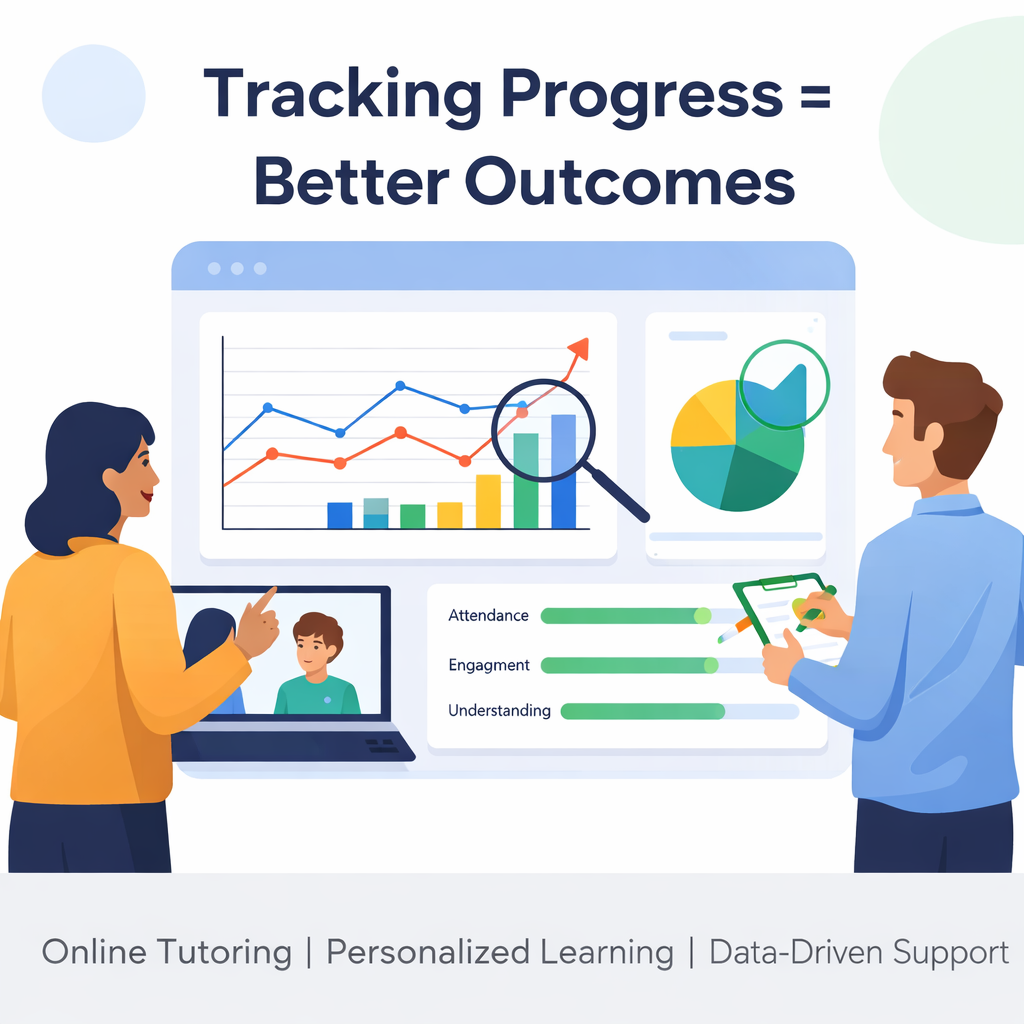
Each student’s progress is monitored through a combination of:
- Attendance tracking – ensuring consistency and identifying patterns
- Engagement levels – measuring how actively students participate in sessions
- Understanding scores – evaluating how well concepts are being grasped
- Topics covered – documenting exactly what is being taught
- Goals and recommendations – setting clear next steps for improvement
This approach allows tutors and program coordinators to move beyond assumptions and base decisions on real, measurable insights.
From Data to Real Outcomes
When progress is tracked consistently, the results become clear.
Across one full academic cycle, students who participated regularly in PLA’s programs:
- Achieved average engagement and understanding scores above 75%
- Demonstrated measurable growth in core skills such as reading, writing, and mathematics
- Many advanced by 5 to 1 full grade level in key subjects
These outcomes highlight an important point:
Progress tracking is not just about reporting—it directly supports better learning outcomes.
Engagement Is Not a Guess
One of the most overlooked aspects of student progress is engagement.
A student may attend sessions regularly but still struggle if they are not actively participating. This is where real-time analytics tools add value.
During live sessions, PLA Virtual classroom tracks insights such as:
- Time spent in session
- Participation through chat and discussions
- Use of audio or webcam
- Responses to polls or activities
- Overall activity/participation scores
These metrics help tutors identify whether a student is:
- actively involved
- passively present
- or disengaged
This allows for immediate adjustments in teaching strategies, ensuring that students remain focused and supported throughout the session.
Tracking Across Different Learning Levels
One of the strengths of structured progress tracking is its ability to adapt across different types of learners.
For example:
K–12 Students
Students often work through foundational concepts such as fractions, algebra, reading comprehension, and grammar. Progress tracking helps identify:
- where foundational gaps exist
- how quickly concepts are being mastered
- which areas need reinforcement
In one case, students progressed from fraction operations into more advanced algebraic concepts such as quadratic equations, with performance tracked through quizzes and tutor observations.
High School Students
At higher grade levels, tracking shifts toward:
- assignment completion
- research skills
- critical thinking
- structured writing and presentations
For example, students may work on science research projects, social studies assignments, and analytical writing tasks, with progress measured through both participation and output quality.
Post-Secondary and Adult Education
For adult education and post-secondary learners, tracking becomes more focused on:
- comprehension of complex concepts
- application of knowledge
- engagement in discussion-based learning
Students working on subjects such as sociology or specialized academic topics benefit from tracking that monitors both understanding and participation across different types of content.
Why This Matters for Schools and Organizations
For schools, community programs, and education managers, progress tracking provides several key advantages:
• Early identification of learning gaps
• Clear visibility into student performance
• Data-driven decision-making for interventions
• Improved communication with families and stakeholders
• Better alignment between instruction and outcomes
This is especially important in programs that support Indigenous communities, remote learners, or students who may require inclusive learning support. In these contexts, having clear and consistent data helps ensure that support is both effective and equitable.
Beyond Academics: Building Confidence and Consistency
Progress tracking is not only about academic performance—it also helps build:
- confidence
- consistency
- independent learning habits
When students can see their own progress over time, they are more likely to stay motivated and engaged.
Similarly, tutors can adjust their approach based on real data, using strategies such as:
- step-by-step instruction
- scaffolded learning
- interactive activities and educational games
- feedback-based practice
These methods support both skills training and long-term learning development.
A More Transparent Approach to Learning
As education continues to evolve, there is a growing need for transparency and accountability in how student progress is measured.
Programs that offer comprehensive tutoring for schools and organizations must go beyond simply delivering sessions. They need to demonstrate:
- what students are learning
- how they are improving
- and where additional support is needed
At Progressive Learning Academy, this approach is built into the structure of the Virtual Learning Centre, where personalized learning, small student-instructor ratios, and consistent tracking work together to support meaningful outcomes.
Final Thoughts
Improving student outcomes requires more than instruction alone—it requires visibility into the learning process.
Progress tracking bridges the gap between teaching and results by providing real-time insights into student performance, engagement, and growth.
For education managers, schools, and community organizations, this means:
- better decision-making
- stronger student support
- and more measurable outcomes
As education systems continue to adapt, approaches that combine live-instructor-led online learning, structured progress tracking, and personalized support will play an increasingly important role in helping students succeed.