
Why Asking Better Questions Is Becoming an Essential Learning Skill
Finding an answer has never been easier.
Students can search the web, watch an explanation, or ask an AI tool and receive information within seconds. But that creates a new educational challenge:
How do learners know whether the answer is accurate, useful, complete—or even the right answer to the question they should be asking?
As access to information grows, the ability to question, evaluate and think critically is becoming an essential learning skill.
Having More Information Doesn’t Always Mean Better Understanding
Today’s learners encounter information from search engines, social media, educational websites, videos, AI tools and countless other sources.
The challenge is increasingly not finding information. It’s knowing what to do with it.
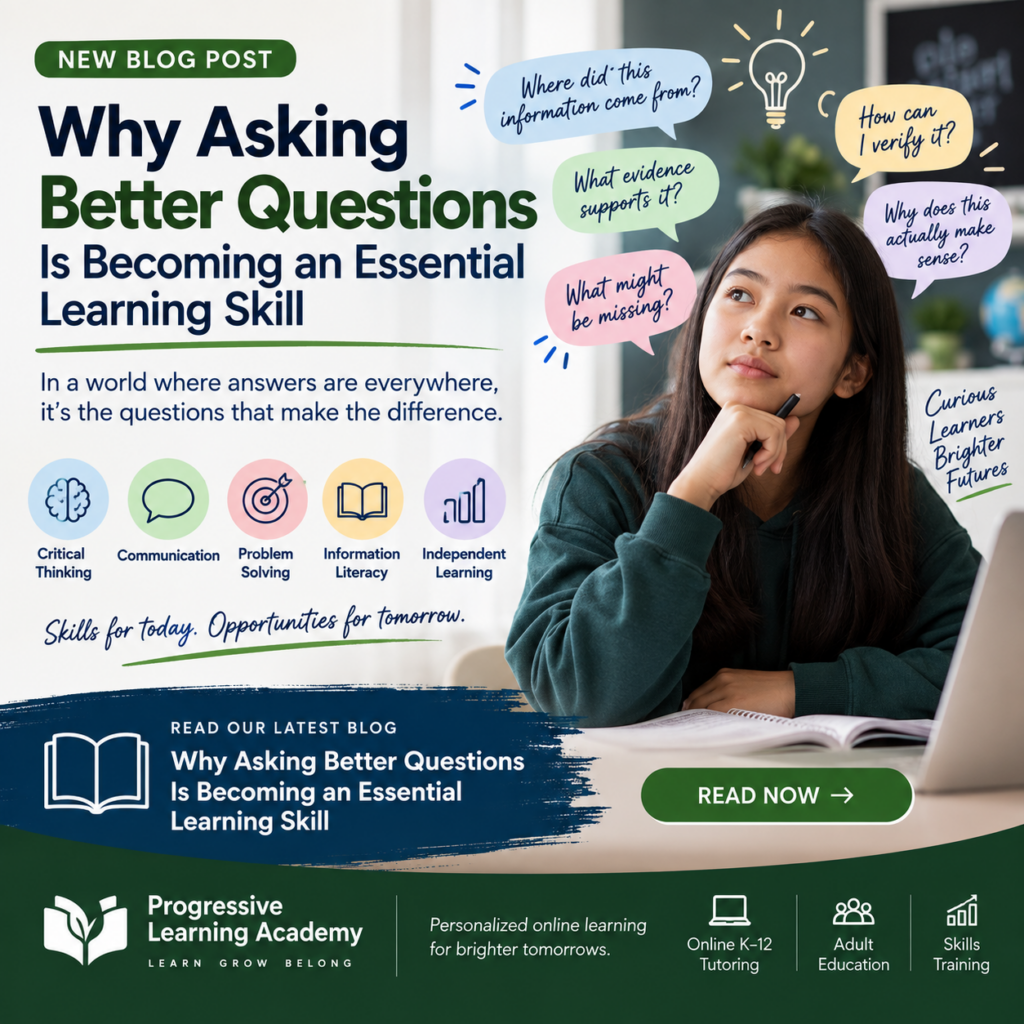
Strong learners need to become comfortable asking questions such as:
-
Where did this information come from?
-
What evidence supports it?
-
Is the source credible and current?
-
What perspective might be missing?
-
Does this explanation make sense based on what I already know?
-
How can I verify it?
These simple questions move a learner from passively receiving information to actively evaluating it.
That’s the foundation of critical thinking.
Better Questions Help Create Independent Learners
Questioning also helps students recognize their own learning needs.
Consider the difference between:
“I don’t understand math.”
and:
“I understand how to solve the equation, but why do we perform the same operation on both sides?”
The second question identifies a specific gap in understanding—and gives an educator something meaningful to work with.
Through personalized learning, online tutoring and online K–12 tutoring, instructors can encourage students to:
-
explain how they reached an answer;
-
identify exactly where they became confused;
-
compare different approaches;
-
ask for clarification when something doesn’t make sense; and
-
reflect on what they still need to learn.
Over time, learners become less dependent on someone simply giving them the next answer.
They begin learning how to learn.
AI Makes This Skill Even More Important
Artificial intelligence makes questioning particularly relevant in 2026.
Students can now generate explanations, summaries, examples and solutions almost instantly. These tools can be valuable learning resources—but only when learners have the judgment to evaluate what they receive.
AI literacy therefore isn’t simply about writing effective prompts.
Students also need to ask:
- Is this accurate?
- What might the AI have overlooked?
- Can I verify this somewhere else?
- Why does this solution work?
- Could there be another interpretation?
The goal shouldn’t be to use technology to eliminate thinking.
It should be to use technology to encourage better thinking.
Questioning Is a Skill That Extends Beyond School
The ability to ask thoughtful questions doesn’t disappear after graduation.
In post-secondary education, adult education, community programs and workplaces, people constantly encounter situations without an obvious answer.
Good questions can help people:
-
clarify expectations;
-
uncover missing information;
-
challenge assumptions;
-
understand another person’s perspective;
-
identify risks;
-
solve problems collaboratively; and
-
make better-informed decisions.
That’s why questioning also connects closely with skills training and workplace & soft skills training, particularly communication, critical thinking, collaboration, adaptability and problem-solving.
These are skills learners can carry into further education, employment and their communities.
Are We Creating Environments Where Learners Feel Comfortable Asking?
This may be the more important question for educators.
A student isn’t likely to ask thoughtful questions if asking for clarification makes them feel embarrassed, rushed or as though they’re falling behind.
Schools, Education Managers and community learning programs can encourage a culture of questioning by:
-
giving learners enough time to think before expecting an answer;
-
using open-ended questions rather than only right-or-wrong questions;
-
encouraging students to explain their reasoning;
-
treating mistakes as opportunities for discussion;
-
recognizing that learners communicate and process information differently; and
-
providing opportunities for individual support when students aren’t comfortable speaking in a group.
Whether learning occurs in a classroom or through live instructor-led online learning, creating space for dialogue can reveal much more about a learner’s understanding than simply checking whether an answer was correct.
For programs serving diverse learners and Indigenous communities, listening to learners and recognizing different experiences, perspectives and learning needs can be especially important when designing meaningful educational support.
From Finding Answers to Developing Thinkers
Education will always involve learning facts, concepts and correct solutions.
But learners also need the ability to encounter something unfamiliar and think:
- What do I know?
- What don’t I know?
- What should I ask next?
At Progressive Learning Academy, our approach to online learning, adult education and skills development emphasizes personalized support that helps learners strengthen understanding, confidence and independent thinking.
Because in a world where answers are increasingly easy to find, knowing which questions to ask may be one of the most valuable skills education can develop.