
Why Reading Comprehension Is More Than Just Reading Words
A student reads a paragraph aloud without hesitation. Every word is pronounced correctly, and the sentences flow naturally.
But when asked to explain what the paragraph means, the student struggles.
Reading fluently and understanding what we read are not always the same thing.
Reading comprehension is a foundational academic skill that influences learning across subjects, from interpreting mathematical word problems to understanding scientific concepts and historical events.
For schools, Education Managers, and community learning programs, recognizing the difference between reading fluency and comprehension is an important step toward providing effective academic support.
Reading Fluency vs. Reading Comprehension
Reading involves several interconnected skills.
Reading fluency refers to the ability to read text accurately, at an appropriate pace, and with expression.
Reading comprehension involves understanding, interpreting, and connecting the information presented.
A student may read every word correctly but struggle to:
- Identify the main idea of a passage.
- Explain what happened and why.
- Recognize relationships between ideas.
- Make inferences using clues from the text.
- Summarize information in their own words.
- Connect new information with existing knowledge.
Both skills matter, but improving reading speed or accuracy alone doesn’t necessarily resolve comprehension difficulties.
Why Do Students Struggle With Reading Comprehension?
Reading comprehension difficulties can arise for several reasons.
Limited vocabulary: Students may recognize individual words without fully understanding their meanings, particularly when encountering unfamiliar academic terminology.
Gaps in background knowledge: Understanding new information often depends on what a learner already knows about the subject.
Difficulty making inferences: Some students understand information stated directly but struggle to interpret implied meanings.
Challenges with attention and working memory: Remembering details, following longer explanations, and connecting information across paragraphs can require considerable mental effort.
Language differences: Students learning English as an additional language may understand a concept but struggle with unfamiliar vocabulary or sentence structures.
These challenges can overlap, which is why personalized learning and appropriate assessments are important when identifying the support a student needs.
A Simple Example: Reading Between the Lines
Consider this short passage:
“When Maya arrived at school, she noticed several students carrying umbrellas. Dark clouds covered the sky, and the wind was becoming stronger. She hurried inside before the first drops began to fall.”
Now consider three questions:
Question 1: What were the students carrying?
Answer: Umbrellas.
This tests the ability to locate information directly stated in the passage.
Question 2: What was the weather probably like?
Answer: Rainy or about to rain.
This requires students to combine clues and make an inference.
Question 3: Why did Maya hurry inside?
Answer: She likely wanted to avoid getting wet when the rain started.
This requires interpreting the character’s actions and connecting them with the surrounding information.
Although all three questions relate to the same passage, they assess different levels of understanding.
A student who answers the first question correctly may still need support with the second and third.
Recognizing these differences helps educators identify where comprehension breaks down.
Five Strategies That Strengthen Reading Comprehension
Effective reading instruction goes beyond asking students to finish a passage and answer questions afterward.
Educators can encourage active engagement with the text through several strategies.
- Build Vocabulary Before Reading
Introduce unfamiliar words and discuss their meanings before students encounter them in a passage.
This reduces confusion and helps learners focus on understanding the overall message.
- Encourage Questions During Reading
Instead of waiting until the end, encourage students to pause and ask:
- What is happening?
- Why is this important?
- What do I think will happen next?
- Is there something I don’t understand?
These questions help students monitor their own comprehension.
- Practice Summarizing
Ask learners to explain a paragraph or passage in their own words.
Summarizing encourages students to identify essential information rather than simply repeat sentences from the text.
- Use Visual Organizers
Story maps, timelines, comparison charts, and diagrams can help students organize information and understand relationships between ideas.
These tools can be especially useful when working with longer or more complex texts.
- Connect Reading to Existing Knowledge
Encourage students to relate new information to familiar experiences, previously learned concepts, or real-world examples.
Making connections helps learners build meaning and retain information.
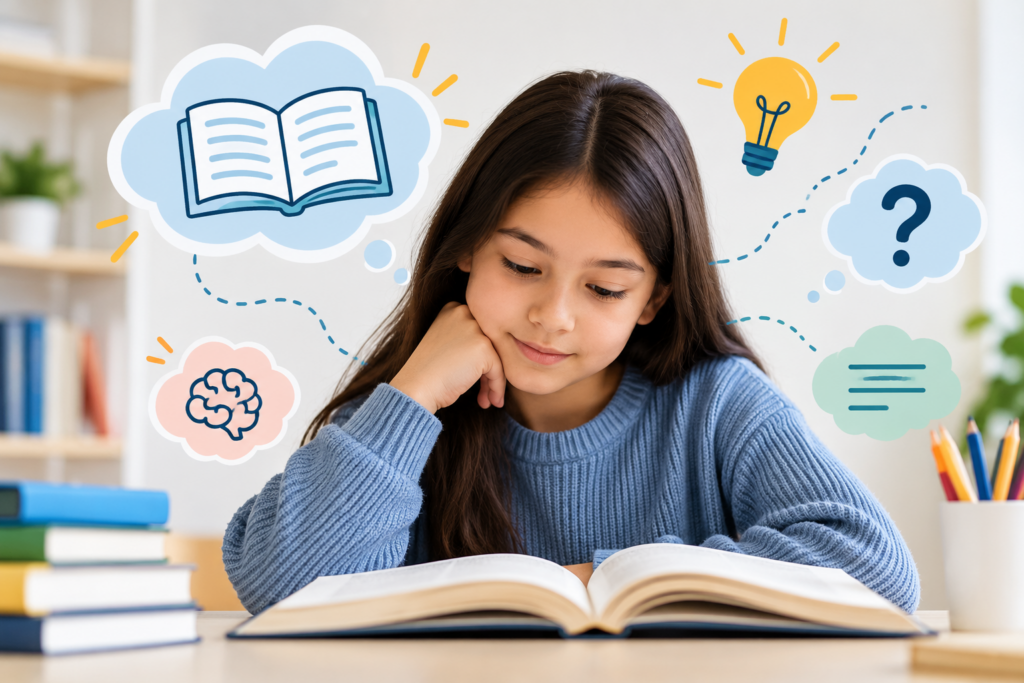
How Can Education Programs Identify Comprehension Gaps
For Education Managers and organizations overseeing academic support programs, identifying reading challenges early can help guide instructional decisions.
Useful approaches include:
- Initial assessments: Determine a learner’s current reading abilities and areas requiring support.
- Individual discussions: Ask students to explain what they have read rather than relying exclusively on multiple-choice questions.
- Targeted instruction: Focus on specific difficulties, such as vocabulary, inference, or summarizing.
- Regular progress monitoring: Track improvements in understanding, not just reading speed.
- Collaboration: Encourage communication between classroom teachers, tutors, and education program coordinators.
Through online K–12 tutoring and live instructor-led online learning, educators can provide individualized instruction, observe student responses, and adjust teaching strategies as understanding develops.
For remote and Indigenous communities, flexible online tutoring can also expand access to additional academic support when local resources are limited.
Building Stronger Readers for Lifelong Learning
Reading comprehension extends far beyond English Language Arts.
Students rely on it when interpreting science textbooks, understanding mathematical problems, researching historical events and evaluating online information.
The same skills remain important in post-secondary education, adult education, and workplace skills training, where individuals must interpret instructions, evaluate information, and communicate effectively.
At Progressive Learning Academy, we recognize the importance of developing foundational academic skills through personalized instruction and ongoing support.